The professional cannot take rejection personally because to do so reinforces Resistance. Editors are not the enemy; critics are not the enemy. Resistance is the enemy. The battle is inside our own heads. We cannot let external criticism, even if it’s true, fortify our internal foe. The foe is strong enough already.
A professional schools herself to stand apart from her performance, even as she gives herself to it heart and soul. The Bhagavad-Gita tells us we have a right only to our labor, not to the fruits of our labor. All the warrior can give is his life; all the athlete can do is leave everything on the field.
The professional loves her work. She is invested in it wholeheartedly. But she does not forget that the work is not her. Her artistic self contains many works and many performances. Already the next is percolating inside her. The next will be better, and the one after that better still.
—From writer Steven Pressfield’s manifesto on overcoming creative blocks, negative thoughts, and fear: The War of Art.

Is Social Rejection the Key to Creativity?
(Vincent) Van Gogh likely had a cadre of mental issues, none of which were suitably diagnosed while he was alive. Yet what seemed to weigh heaviest on him was the inevitability of his loneliness.
On the psychology of why rejection and loneliness may be necessary evils for the creative genius
“In the deepest and most important things, we are unutterably alone, and for one person to be able to advise or even help another, a lot must happen, a lot must go well, a whole constellation of things must come right in order once to succeed.” — Rainer Maria Rilke

Vincent Willem van Gogh was born on March 30, 1853, in a small town in the southern Netherlands. At age 13 he attended Willem II College, a nearby middle school. An artist from Paris by the name of Constantijn C. Husymans taught at the school, and it was he who first exposed the young van Gogh to drawing. Two years later, however, van Gogh grew frustrated with his schooling and returned home. “My youth was gloomy and cold and sterile,” he would later write to his brother Theo in a series of letters now collected as The Letters of Vincent Van Gogh.
He subsequently moved to Paris and famously made a name for himself as a painter. Still, he suffered often with bouts of depression and gloom. At age 36, he decided to move to Auvers-sur-Oise, a sleepy town in northwestern France, where he could be nearer to Theo and to a psychiatrist named Dr. Paul Gachet, who was recommended to van Gogh by friend and fellow painter Camille Pissaro. Jan Hulsker, a Dutch art historian, notes that upon moving to Auvers-sur-Oise, van Gogh suffered a new crisis, “the starting point for one of the saddest episodes in a life already rife with sad events.” For a year van Gogh “had fits of despair and hallucination during which he could not work, and in between them, long clear months in which he could and did, punctuated by extreme visionary ecstasy,” writes art critic Robert Hughes.
Around this time, van Gogh wrote another letter to his brother, this time about his loneliness. Even if he were to have a friend for whom he cared, van Gogh felt that it would only serve to lead him away from his art.
“We feel lonely now and then and long for friends and think we should be quite different and happier if we found a friend of whom we might say: ‘He is the one,’” van Gogh wrote. “But you, too, will begin to learn that there is much self-deception behind this longing; if we yielded too much to it, it would lead us from the road.”
The next year, on July 27, 1890, a 37-year-old van Gogh is alleged to have shot himself in the chest with a revolver. “Some think Van Gogh shot himself in the wheat field that had engaged his attention as an artist of late; others think he did it at a barn near the inn,” writes biographer Ingo Walther. Van Gogh walked to the Auberge Ravoux, a lodge where he had recently been staying. Two doctors attended to him but without a trained surgeon present the bullet could not be removed. Theo was notified and rushed to be with his brother. The next evening, however, an infection caused by the bullet killed van Gogh. He spent his final evening smoking a pipe and chatting with Theo. His final words were, “The sadness will last forever.”
Van Gogh likely had a cadre of mental issues, none of which were suitably diagnosed while he was alive. Yet what seemed to weigh heaviest on him was the inevitability of his loneliness. According to his letters to Theo, he felt he had one of two options: content himself with loneliness or try to countenance his loneliness with friendships thereby derailing his creativity (“lead us from the road,” as he wrote).
Aldous Huxley wrote, “If one’s different, one’s bound to be lonely,” and upon thinking about it even a little, it quickly becomes apparent that many of history’s creative geniuses have been deeply lonely people. There is the obvious reason for this: dedicating oneself to an artistic pursuit means one has little time for social endeavors. This is what has frustrated flamboyant, gregarious writers like F. Scott Fitzgerald and Henry James, both of whom wrote about the dreadful isolation necessary to turn out great fiction. But whether it’s the mysteriously secretive writing careers of J.D. Salinger or Donna Tartt, the well-known loneliness of Joseph Conrad (“we live as we dream — alone”) or the friendship-loneliness conundrum of van Gogh, it becomes apparent that something else is at play. Loneliness is not just sufficient for creativity; it is necessary. It is almost as if one can only be truly creative when one detaches from society.
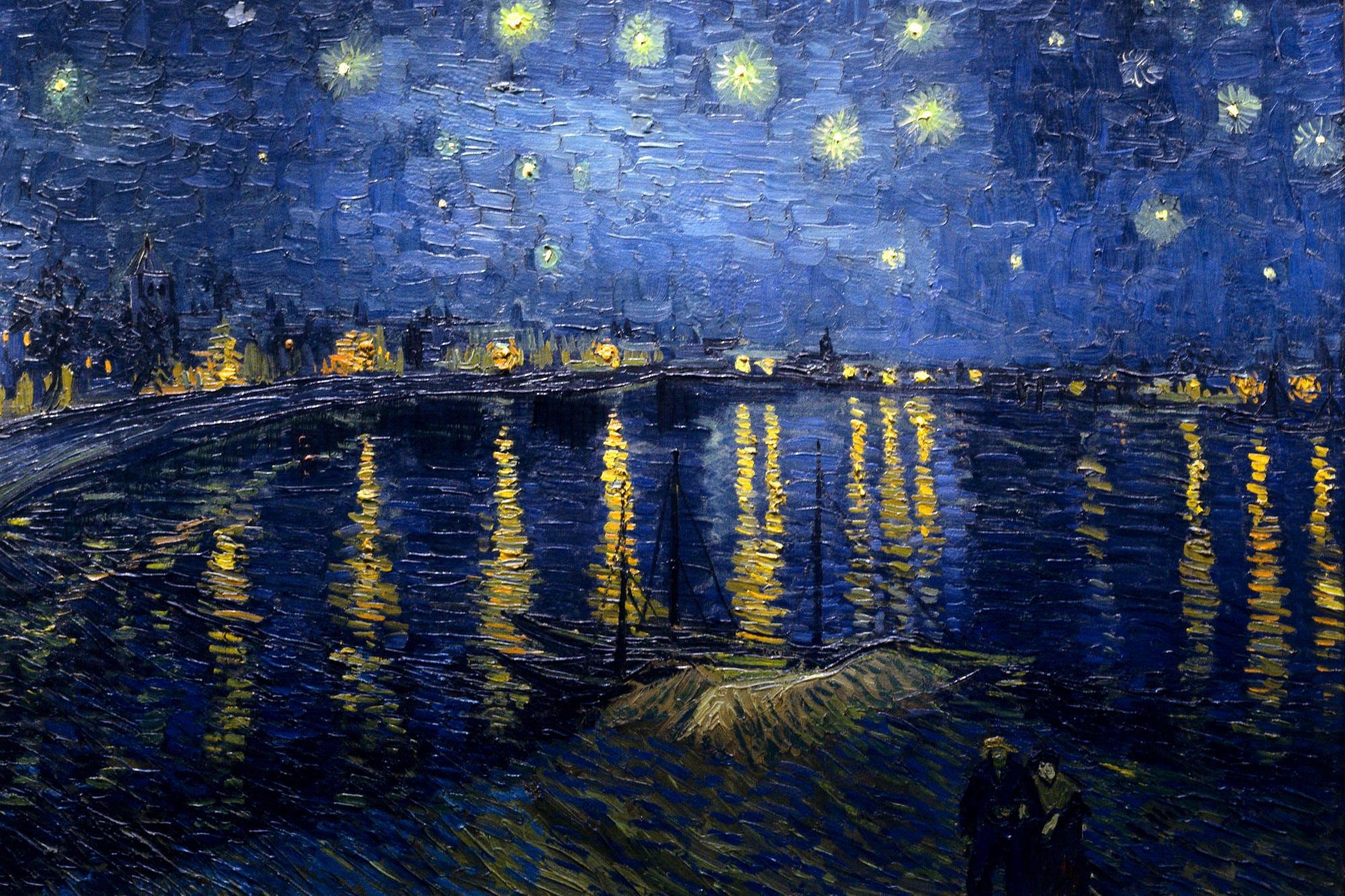
“Starry Night Over the Rhone,” 1888, Van Gogh, Musée d’Orsay, Paris

Sharon H. Kim is an assistant professor at Johns Hopkins University who focuses on individual and group creativity. She did her undergraduate work at the Ohio State University and completed her doctorate at Cornell. She has jet-black hair and chunky black spectacles to match. In her most recent study, she found evidence that people tend to be more creative if they have been socially rejected.
What is perhaps most interesting about her findings is that no actual social rejection has to have taken place, the creative must only feel rejected in some way and must establish a feeling of independence, of being “different” than his or her peers.
In the 1956 book The Outsider, Colin Wilson claimed that creative geniuses tend to live on the margins of society, rejected and non-conformist. Yet, a neurological nuance must be added to Wilson’s well-known theory. When creativity becomes all that matters — when dreams of fitting in with society and having a white picket fence fall by the wayside — then one’s cognitive focus can move from socio-cultural ones (fitting in) to creative pursuits(standing out).
“Given that creative solutions are by definition unusual, infrequent, and potentially controversial, they are stimulated by the desire to stand out and to assert one’s uniqueness,” writes Kim. “The experience of rejection may trigger a psychological process that stimulates, rather than stifles, performance on creative tasks.”
Scholars didn’t always think like this. In fact, Kim quotes a series of studies, principally Roy Baumesiter’s 2005 study, which claimed that social exclusion hinders cognitive performance and therefore decreases one’s ability to be creative. But Kim flatly rejects this claim, asserting that loneliness and the feelings of rejection instead allow one to better focus cognitive performance on a single, creative task.
Think of it like this: You go to see a play with a friend. During the play you’ll likely be wondering what your friend is thinking of the show, what quarrels he or she will take with it, what your discussion will be like on your walk home. But if you go to the theatre by yourself, all of your concentration can be directed on what’s happening on stage. Your mental energy is focused.
When we let our focus shift away from the people and things around us, we are better able to engage in what’s called “meta-cognition,” or the process of “thinking critically and reflectively about our own thoughts,” as psychology professor Gregory Feist says.
The difficulty lies in striking a balance. There is solitude, which can lead to meta-cognition and creative focus. But there is also, as van Gogh experienced off and on throughout his life, crippling loneliness that sets the artist back. The gap is razor-thin. Loneliness and depression (Hemingway called depression “the artist’s reward”) are central to why so many great artists from Hemingway to Plath to Hunter S. Thompson have taken their own life. Sartre is alleged to have said, “If you’re lonely when you’re alone, you’re in bad company,” but parsing the distinction between solitude — where one is willfully and happily alone — and loneliness — where one is desperate and depressed to be alone — is a task that should not be taken lightly. “Solitude gives birth to the original in us, to beauty unfamiliar and perilous, to poetry,” wrote Thomas Mann. “But also, it gives birth to the opposite: to the perverse, the illicit, the absurd.” He might have added: to the crippling, the desperate, the depressing.
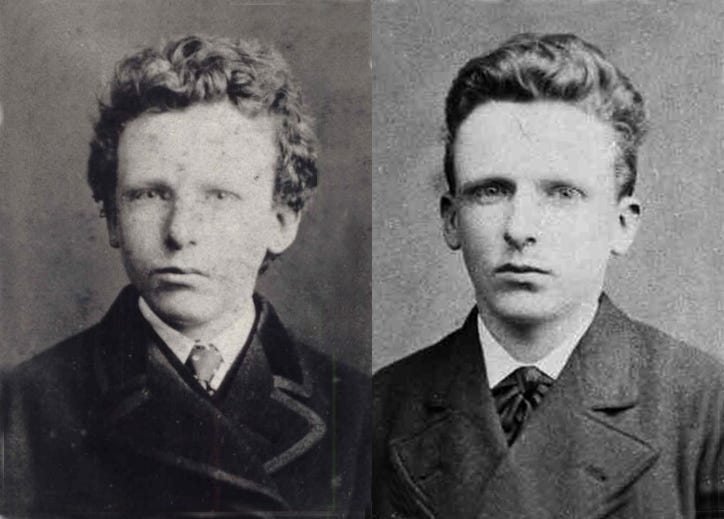
Vincent Van Gogh (left) and his younger brother, Theo (right), 1887
Modern studies have shown how great a challenge it is to differentiate between loneliness and solitude. One wants to “treat the loneliness while strengthening the solitude,” writes psychotherapist Edward Tick. The trouble is that solitude may not be enough for creative genius because it entails no rejection. Loneliness, however, is the product of rejection, either a rejection inflicted by society or inflicted on oneself and therefore lends itself most to creativity.
Yet, one must wonder, is it possible that creating great art is such a momentous act that loneliness and social rejection cease to matter? In a letter to a seventeen-year-old aspiring author called Leonard, the French-born author Anaïs Nin wrote, “Great art was born of great terrors, great loneliness, great inhibitions, instabilities, and it always balances them.” The composer Pyotr Ilyich Tchaikovsky also seemed to strike this balance. He was notoriously depressed and, as a gay man in nineteenth-century Russia, surely felt socially rejected. But when he had a creative breakthrough all of that went away. “It would be vain to try to put into words that immeasurable sense of bliss which comes over me directly a new idea awakens in me and begins to assume a different form,” he wrote to his financier and friend Nadezhda Filaretovna von Meck in 1878. “I forget everything and behave like a madman. Everything within me starts pulsing.”
But this may be a balance that only a select few can endure. Creativity stems from the ability to make original, unique connections, to bind together disparate information in a way that few are able to accomplish. “Creative people are better at recognizing relationships, making associations and connections, and seeing things in an original way — seeing things that others cannot see,” writes neuroscientist Nancy C. Andreasen. Often, the only way to see what others cannot see is to experience what others cannot imagine experiencing: rejection, isolation, loneliness. The trouble is that rejection, isolation, and loneliness are awful emotions to have to endure. Few can withstand them for a few years. Almost no one can withstand them for a lifetime.
Even a genius like van Gogh could not deal with the social detachment that he felt his creativity demanded. Still, he felt it worthwhile. On October 14, 1875, van Gogh wrote another letter to brother, counseling him to reject society. “Seek only for light and freedom and do not immerse yourself too deeply in the worldly mire,” he wrote.
Six months after Vincent died of an infection, Theo died as well. Theo’s medical report, according to biographer Wouter van der Veen, noted that he died of dementia paralytica brought on by “chronic disease, overwork, [and] sadness.” Van der Veen also wrote that Theo’s health degenerated in large part due to his brother’s death. Without Vincent, Theo, who also struggled with loneliness, felt more alone than ever.
Finally, in 1914, over twenty years after Theo’s death, Theo’s body was exhumed and moved to Auvers-sur-Oise to be next to Vincent’s grave. Now the brothers could rest — together.

When life hands you lemons…...

One of my supervisors said to me: In the time it takes to do a PhD, statistically, one or more major life events are sure to happen to you – births, deaths, marriages, relationship breakdowns, moving house, etc.
Students self-efficacy beliefs about reading and their reading performance
Students who experience reading difficulties think of themselves as poor readers. For these students, word identification is difficult and they depend on intervention for assistance. Such students search for basic meaning and their reading is often passive. They seldom re-read, self-correct or engage with the text. Most of these students who experience such reading difficulties do not believe they can be successful readers. The beliefs of these students about reading require change and transformation. When interactions with text are meaningful and thoughtful, students perceive themselves as readers and this leads to independence and enhances self-efficacy beliefs. Such beliefs are shown to relate to reading performance and achievement.
Self-efficacy and children’s learning
In terms of children’s learning, self-efficacy is the belief that a child creates and develops about himself/herself and this belief is an important force in his/her success or failure. The concept of self-efficacy is particularly important in the classroom context because it determines the extent to which an individual will persist in any task (Bandura, 1977).
Bandura’s social cognitive theory
In Bandura’s social cognitive theory there are three main components that interact with each other to determine a person’s behavior when performing a particular task. The three components are personal, environmental and behavioral factors (Crothers, Hughes, & Morine, 2008). This means that peoples’ performances are affected by the interactions between the self and the environment. Personal factor is one of the components of the social cognitive theory which Bandura refers to as self-efficacy beliefs. Self-efficacy beliefs describe human behavior as part of the interaction between a person’s cognitive processes, the environment, and his or her behavior.
Another component of social cognitive theory is the environmental factor. The environmental factor refers to external factors or stimuli from the social and physical environment that can affect a person’s behavior (Bandura, 1986). Feedback, for example, is an important aspect of the environmental factor which affects self-efficacy beliefs (Akkuzu, 2014). According to Hattie (2009), feedback can affect how students feel about themselves. Feedback can make good students feel better and less able students feel worse. This means feedback needs to be clear, purposeful, meaningful and compatible with students’ prior knowledge and provide logical connections (Hattie, 2009).
The final component of the social cognitive theory is the behavior that is shaped and controlled by environmental influences. According to Bandura (1986), human functioning is the result of the interaction among these three factors. This means that environmental factors (e.g. feedback) affect both personal factors (e.g. self-efficacy belief) and behaviors (e.g. performance) (Akkuzu, 2014). Therefore, a person’s performance is dependent not only on self-efficacy beliefs but also on feedback and on the behavior itself.
Where does self-efficacy come from?
Self-efficacy beliefs are derived from four sources of information (Bandura, 1997). These sources of information are: mastery experiences, vicarious experiences, verbal persuasions, and psychological states. Mastery experience is our personal experience with success or failure. For example, a student may succeed or fail in reading a challenging book, therefore increasing or decreasing his/her confidence for future reading tasks (Bandura, 1997; Usher &Pajares, 2008). Vicarious experiences are observing the experiences of others. Students observing a model successfully perform in a challenging situation are more likely to develop an expectation that they can acquire the same skill (Bandura, 1997; Usher &Pajares, 2008). Verbal persuasion is employing verbal feedback to convince or encourage the learners to accomplish the tasks. Verbal feedback influences students’ beliefs about their ability to do an activity, especially when the feedback is from their teachers, parents, coaches and friends. For example, according to Scott (1996), when students receive strong messages that they are capable of handling a situation because they have the skills to do so, they are more likely to put in extra effort and persist when they are faced with challenges. Psychological states are students’ feelings, such as anxiety, fear, fatigue, or pain; these symptoms or mental states reflect the learners’ perception of their self-efficacy and affect their performance (Bandura, 1997).
What is self-efficacy?
Self-efficacy has been defined as a person’s belief in his/her ability to succeed in particular situations and it plays a critical role in how people think, feel and behave (Bandura, 1977). It is one’s belief in oneself to succeed and achieve. That is, what I think and feel and how I behave depends on the level of self-efficacy I have at that particular time and place. Self-efficacy is a concept first developed by Bandura (1977) as part of a larger theory, the social learning theory (Ashford & LeCroy, 2010) which has developed into social cognitive theory (Levin, Culkin, & Perrotto, 2001), to demonstrate that self-efficacy can have an impact on everything from psychological states to behaviour and motivation. Self-efficacy plays a major role, according to Bandura, in how goals, tasks, and challenges are approached.
Student’s self-efficacy beliefs about reading
A student’s self-efficacy is a student’s judgment about being able to perform a particular activity (Bandura, 1977). It is a student’s “I can” or “I cannot” belief which reflects how students feel about their worth or value; self-efficacy reflects how confident students are about performing specific tasks. However, according to Bandura (1986), self-efficacy is specific: high self-efficacy in one area like maths may not coincide with high self-efficacy in another area, for example, reading. A student’s self-efficacy beliefs about reading will therefore influence reading performance and achievement in the classroom. Self-efficacy about reading influences how a student perceives himself/herself as a reader, how a reader approaches reading tasks and the reading processes, as well as whether or not he/she likes to read (Seeger, 2009). Students’ self-efficacy about reading is when students feel they will be successful at reading tasks, and “they are likely to exhibit a willingness to engage in reading” (Vacca & Vacca, 2008, p.187).
Students’ self-efficacy beliefs about reading are influenced by their experiences as readers. Often, students who perceive themselves as good readers have ongoing positive experiences with books. They enjoy reading, are interested in reading activities, find challenging reading materials and persevere in pursuing comprehension (Henk &Melnick, 1995). Henk and Melnick (1995) also provide a portrait of students who see themselves as poor readers. These students have not encountered many positive reading experiences. They do not think of reading as a source of pleasure. They avoid reading and put little effort into it because they are afraid they will fail anyway. Comprehension is too difficult for them and is often not achieved at all. All of these features impact students’ self-efficacy.
Attention to students’ characteristics alone is not enough. To produce optimal reading growth, enhancement of students’ beliefs about their ability to read text, select and use strategies and monitor their own reading, is very important (Casteel, Isom & Jordan, 2000). This is because research on reading motivation indicates that children who feel competent and efficacious about reading are more likely to engage in reading including reading outside of school hours (Wigfield, 1997). Anderson, Wilson and Fielding (1988) found that increased engagement in reading outside of school hours accounted for 16% of the variance in the reading comprehension of fifth graders. However, Schunk and Pajares (2002) stated that “no amount of efficacy will produce competent performance when requisite skills and knowledge are lacking” (p. 16).

